
Four Counter Intuitive Ideas
At least they run against my "tuit"!

Have you ever thought about your soul, can it be saved? Or perhaps you think that when you are dead, you just stay in your grave. Is God just a thought within your head or is he a part of you? Is Christ just a name that you read in the book when you were in school?
-Black Sabbath
It was the last place I expected to find a song urging people to think about Jesus. It turns out that Geezer Butler, the bassist of Black Sabbath, was raised Catholic. Lead singer Ozzy Osbourne was a practicing member of the Church of England who prayed before each show, and guitarist Tommy Iommi believes in God but has not attended church since childhood. In 2017, he wrote a choral work called "How Good It Is, with lyrics inspired by Psalm 133.
By 1971, the band was tired of being called Satanists. Butler wrote, and Black Sabbath recorded, After Forever, described as a pro-Christian song calling for people to be open-minded and consider the possibility of God’s existence.
“Who’da thunk it?” The band called Black Sabbath encouraging fans to consider God.

The truth is often more complicated than we assume. It made me think of a trio of other counter-intuitive things I have learned over the years.
One:
The first books of the New Testament are the stories of Jesus’ life. Matthew, Mark, Luke, and John are followed chronologically by the book of Acts, which follows the disciples taking the news of Jesus’ death and resurrection from Jerusalem to Rome. Then there are a series of letters written by Paul to churches in various towns and cities in the Roman Empire. So, it seems obvious that the gospels were written first, then Acts, and then Paul’s letters.
But that is not what we find when we look at the dates! The gospels were written between 75 and 100 A.D. while Paul’s letters were written one to two decades earlier.
AD. 70-75: Mark’s gospel, according to the majority of scholars.
A.D. 75-90: The Gospel of Matthew.
A.D. 80-90: The Gospel of Luke
A.D. 90-100: The Gospel of John
By contrast:
About 50 AD: Paul’s first letter to the people of Thessaloniki. (1 Thessalonians)
Approximately 55 AD: Paul’s letter to the people of Galatia.
Around 55 AD: Paul’s first letter to the Corinthian church.
Autumn 57 AD: Paul’s second letter to the Corinthians.
Winter 57 AD: Paul’s letter to Romans Christians.
Around 61-63 AD: Paul’s letter to the Christians in Philippi.
These counter-intuitive facts put a bit of a wrench in the skeptical idea that Paul took Jesus’ religion and created something different. How could that be if Paul wrote his letters 20 years before the published sources that tell us about Jesus’ teachings?
Two:
Oftentimes, the older something is, the more venerable it is. Thus, the King James Version (KJV) of the Bible, published in 1611, is worthy of greater respect among many Christians than a more modern version such as the New International Version (NIV), published in 1978.
But…
The New Testament translation of the NIV is derived from, among other sources, the fourth-century Codex Sinaiticus, one of the earliest complete manuscripts of the New Testament. It wasn’t discovered until the mid-19th century.
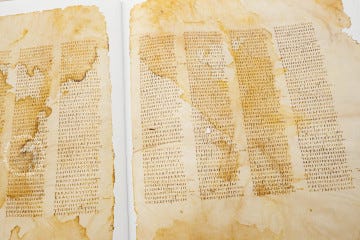
The New Testament translation of the KJV, on the other hand, was derived primarily from the Textus Receptus, first compiled in 1516.
With the translation of ancient manuscripts, the closer the source text is to the events described the more it can be trusted as a reliable translation. Counter-intuitively, then, the NIV is more reliable in this sense than is the KJV.
Three:
While skeptics doubt the reliability of the Bible, they accept without question the reliability of the writings of Homer, Plato or Julius Caesar. However, a closer look at the facts regarding the historical reliability of these ancient texts offers us a counter-intuitive thought.
Two key data points in this regard are:
(1) The number of surviving manuscripts. This allows earlier manuscripts to be compared with later ones to see how accurately they were transmitted across time. The number also proves how widely they were used and valued by various communities, providing an additional safeguard against one group altering the text to their tastes without others noticing.
(2) The number of years that have passed between the composition of the text and the first manuscript copies that were made. Of course the fewer years that have passed between them the more we can trust the copy as reliable.
With that in mind, let’s look at some numbers.
The New Testament boasts over 24,000 manuscripts in various languages, including Greek, Latin, Syriac, and Coptic, while most ancient works survive in fewer than a dozen. Even works by well-known classical authors like Homer or Plato have around 1,500 and 200 manuscripts, respectively.
The earliest New Testament manuscripts in existence date from 100 to 300 years after the original writings. That may sound like a lot. But compared to the writings of other historical figures, like Julius Caesar, it isn’t. Many of the earliest manuscript copies were made 1,000 years after their time.
We have 20 copies of the works of Tacitus, a Roman historian and politician born around the time Paul was writing his second letter to the Corinthians. The earliest copy of his work was produced by the Benedictine Abbey of Fulda in Germany. Entitled The Annals, it dates from 1,000 A.D.
The dialogues of Plato were written around 399-347 BC. In 895 A.D. John the Calligrapher of Constantinople copied about 1/2 of those dialogues for Arethas of Patrae, later Bishop of Caesarea. His copy, known as the Clarke Plato, is the oldest surviving work of Plato. Today there are about 250 ancient copies of Plato’s dialogues.
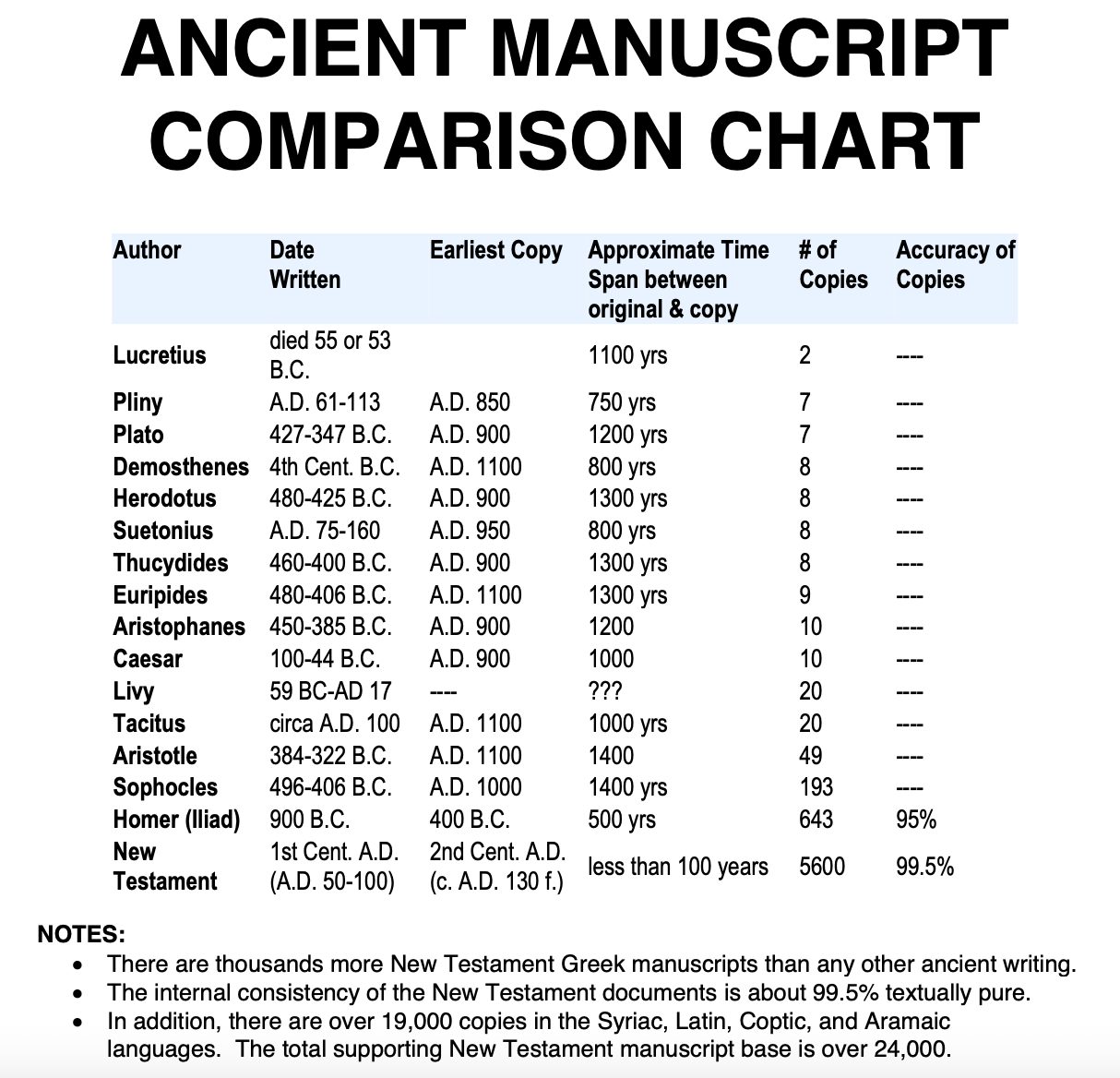
When we compare ancient manuscripts using historical data, we find that the Bible is reliable! Even compared to other ancient texts we never think to doubt.
We are awash in information that affects what we trust and what we fear in everyday life. I find it incredibly liberating to test common views and opinions with data that could lead me to a counterintuitive idea. What opinions affecting your life need to be tested by data?
This is so fascinating to me, Randy. As a Christian I believe fully the God-breathed words of scripture. But this is helpful to me in that it might assist me in speaking and sharing with others who have questions about Christianity, especially when it comes to the validity of the scriptures. Thanks so much for this! 😊