
Great Cloud of Witnesses
Richard of Chichester: A Compendium Entry

Imagine there’s no countries, It isn’t hard to do,
Nothing to kill or die for, And no religion, too
Imagine all the people, Livin’ life in peace. -John Lennon, 1971
It was an attempt to draw everyone together at the end of the year. The “Winter Solstice” celebration at my son’s Elementary School, located right around the corner from our church, included the Hanukkah song for kids, “Dreidel,” describing the spinning top game, and “Imagine” by John Lennon. The faith that I held wasn’t mentioned in the school program. The children’s choir sang, “Imagine there’s no heaven, It’s easy if you try, No hell below us, Above us, only sky…” The lyrics resonated deeply with many of the parents. They were wiping away tears as the song continued, “Imagine all the people, Livin’ for today…” The challenge before me, as a new pastor in this community, was clear: How could I help these people see that Jesus’ life, death, and resurrection was actually good news for everyone?
This was more than 20 years ago. Since that time, the challenge has only become more difficult. Modern Western Christianity simply doesn’t influence our imagination in the way it did before the 1950s. It isn’t that the gospel message needs to change. The problem is that the way that we speak of Christianity, the way we practice our faith, does not communicate good news to our fellow citizens. In the same way, the King James translation, in its beauty, actually makes it more difficult for people to understand the Bible today, simply because the English language has changed so much in the more than 400 years since it was published.
Western Christians sensed the need for a fresh translation of the Gospel message in the 1970s. Drama students at Carnegie Mellon University put together Jesus’ parables, largely from the Gospel of Matthew, into a two-act play called Godspell. After a successful run the play was redeveloped as an off-Broadway production, including a song by Stephen Schwartz entitled “Day by Day.” The production opened the same year as John Lennon’s Imagine.

Day by day, Day by day, Oh Dear Lord, Three things I pray:
To see thee more clearly
Love thee more dearly
Follow thee more nearly
Day by day. -Day by Day by Stephen Schwartz
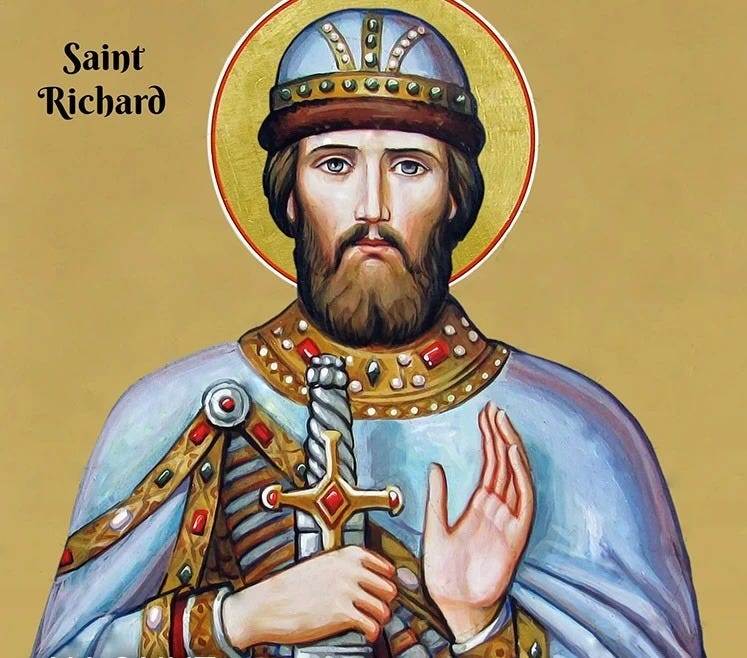
Schwartz’s source was a prayer, penned centuries earlier, by Oxford graduate and British Bishop, Richard of Chichester. Richard was born in 1198 in Droitwich, England. During his life, as the bishop of Chichester, he championed a Christian life far more robust than the common stereotypes, like John Lennon’s of Christians in our day. For example, he followed a rubric known as the ideals of St. Edmund of Abingdon, which include a strong emphasis on things like:
Holiness & Prayer: A life of deep prayer, meditation, and ascetic practices seeing holiness as the ultimate goal.
Academic Pursuit: A renowned scholar at Oxford and Paris, introducing Aristotelian philosophy and dedicating his lecture fees to building the Lady Chapel at Oxford.
Justice & Reform: An uncompromising advocate for justice, discipline, and moral integrity in church and state, challenging corrupt officials and powerful figures.
Service to God & the Poor: A commitment to knowing, loving, and serving God, giving generously to the poor and ensuring church resources served the needy, not luxury.
Church Independence: Believed the Church should be free from political interference, led by dedicated men, and focused on spiritual work.
The Godspell play was a long-running success, but it was Shwartz’s song, Day by Day, that became part of our cultural consciousness. People who have never seen the play remember the song. It has been covered by the likes of Shirley Bassey, the Fifth Dimension, Andy Williams, Judy Collins, and even Homer Simpson.
But there were problems with this fresh translation of Jesus’ story from the get-go. The death of Jesus, the focus of so much of Matthew’s gospel, is part of Godspell. But the resurrection of Jesus, which is the moment toward wich all gospels take their readers is missing.
Schwartz’s edit of Richard of Chichester’s prayer also leaves out a significant part of his prayer.
Thanks be to you, Lord Jesus Christ,
for all the benefits which you have won for us,
for all the pains and insults you have borne for us.
O merciful Redeemer, Friend and Brother…
It is only after this expression of gratitude for the relationship we have with God through Jesus’ death on the cross that he utters the more familiar part of his prayer:
Thanks be to you, Lord Jesus Christ,
for all the benefits which you have won for us,
for all the pains and insults you have borne for us.
O merciful Redeemer, Friend and Brother,
may we know you more clearly,
love you more dearly,
and follow you more nearly,
day by day. Amen.
A fresh translation was needed to help the 60s generation imagine a robust Christianity like that reflected in Richard’s prayer. Many Christians greeted Godspell with hope for the future of the faith. But without the resurrection, the musical could only murmur a pale expression, and Christianity continued to decline.
We still need a fresh translation of the faith for our generation. Richard of Chichester’s prayer is a great place to start. If we pray his prayer regularly, and live our lives “day by day” in relationship with the resurrected Christ, our lives will become a fresh translation of the good news, enabling those around us to imagine what is possible for us all in Jesus.
This is wonderful, Randy, and so interesting to me. I remember hearing this song sung in my high school’s weekly chapel service back in the 1980s and had no idea about its origins. All I knew was that the heartfelt and searching tone of its music and words touched me. Thank you for sharing with us here the history of it in its totality! I really enjoyed reading it! 🙂
Gosh, doesn’t that preach! Without the resurrection, there is no miracle in Jesus’s or His impact on humankind for 2000+ years