

“…every word we use comes to us colored from all its adventures in history…” -G.K. Chesterton1
It was quite a scrap2. It could, perhaps more appropriately, be labeled a brawl.3 Not simply because of the word's meaning, but because of each word's availability or lack thereof when the event occurred. Let me explain:
It began when a Scot, maybe a James Stewart, a Robert Campbell, or a Margaret MacDonald, deftly dodged a haymaker in a move so unexpected they needed to coin a new word to describe it.
This was around 1510, three hundred years before the word “scrap” related to a fight. “Brawl” became common as a description of a noisy disturbance a decade or two later. At the time, “haymaker” simply meant “one who cuts and dries grass.” But someone who saw the quick move that kept the punch from landing called the move a “jook.” With this, the adventure of our word of the month began. This journey would continue for 400 years. It isn’t over yet.
We’ve forgotten something very important our ancestors valued: enjoying the sound of words. We forget to laugh at the humor inherent in words like humbug, bambosh, baloney, bunkum, hogwash, flapdoodle, hocus-pocus, flim-flam, flumadiddle, rubbish, hooey, hot air, motormouthing, poppycock, and malarkey. Our word shared the comic feel of these words at the start. A character that remained as it was shaped and molded and joined with another word over the ensuing centuries.
But back to our word. In its early years in Scotland, it grew from the nascent form “jook” into the adolescence of “joukery,” a Scottish term for trickery or underhanded dealing. There it stayed until a suitable partner was found.
About a century later, among a driggle-draggle4 consisting of far too many individuals one could describe as “huff-snuff,”5 another Steward, Campbell or MacDonald, came along who was involved in joukery, but who did so with real flair (though in that day the word “flair” meant an odor related to hunting).6 Ewan or Aileen had a quirky, artistic sort of joukery, a roughish quality a bit like the Han Solo character in Star Wars. A new word was needed. Neighbors began calling them “pawky.”
Then, in the 1680s, pawky met joukery. The rest is history.
In the 1680s, George Stuart wrote A Joco-Serious Discourse in two Dialogues, between a Northumberland-Gentleman and his Tenant, a Scotchman. He needed a word that described a kind of trickery that was almost attractive. So, he consecrated the marriage of our two words: “Deil fecht was it but Jewkrypawkry.7”
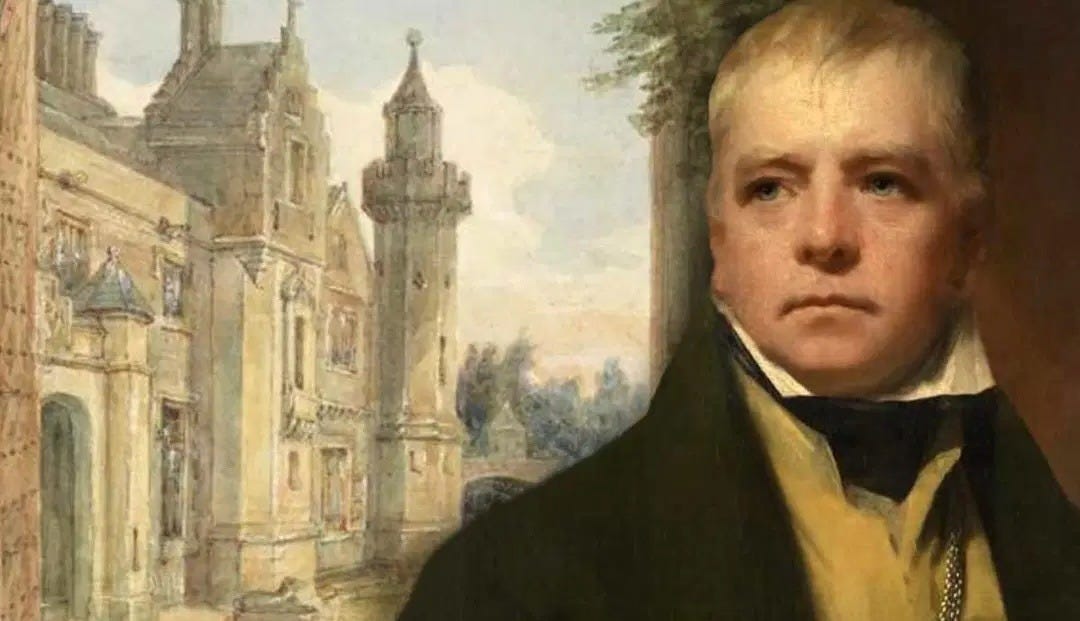
After an extended, 200-year honeymoon in their homeland of Scotland, they found employment with Sir Walter Scott. Scott was, rather unsurprisingly given his last name, a Scotsman. Yet he was widely read in England. He introduced our couple, along with many other Scottish words, to his English readers in novels like The Black Dwarf, which includes the line: “There has been some jookery-paukery of Satan’s in a’ this!”
In their new home in England, “jookery-paukery” began another transformation. An English journal first published in 18738 includes the following paragraph:
In common use amongst the lower orders, to give the idea of something not quite straightforward, e.g. a stableman giving it as his opinion when the “favourite” lost a race, that there had “been some jokery-pakery in the stable.” The words have rather an Eastern sound. Sometimes I have heard it pronounced “jiggery-pokery,” but that sounds more corrupt.
It may surprise you to know that “Jiggery-pokery” continues to exist in essays, famous children’s books, and even legal court decisions to this day.
In a 1940 essay, George Orwell argued that forming new words is essential to accurately describing mental processes and societal changes, emphasizing that language must evolve to remain relevant and effective. He used “jiggery-pokery” while making his case.
In 1 Harry Potter and the Chamber of Secrets, first published in the UK in 1998, J.K. Rowling’s main character uses the term.
“Jiggery pokery!” said Harry in a fierce voice. “Hocus pocus — squiggly wiggly —”
“MUUUUUUM!” howled Dudley, “He’s doing you know what!”
Our term even crossed the pond when, in 2015, U.S. Supreme Court Justice Antonin Scalia argued against his colleagues’ reasoning in a healthcare subsidy case, calling it “interpretive jiggery-pokery.”
The next step in this long-lived couple's journey is up to you. Will you have fun with them? If so, how will you use “jiggery-pokery” in your conversation today?

William Blake by G.K. Chesterton, p. 2.
Scrap: “a fight, struggle, tussle,” 1846, possibly a dialectal variant of scrape (n.1) on the notion of “an abrasive encounter” [Century Dictionary]. Weekley and OED suggest obsolete colloquial scrap “scheme, villainy, vile intention” (1670s). Etymonline
Brawl: mid-15c., “noisy disturbance,” from brawl (v.). The meaning “fist-fight” is by 1873. Eymonline
Driggle draggle: drab.
Huff-snuff: a conceited person.
Flair: mid-14c., “an odor,” from Old French flaire “odor or scent,” especially in hunting, “fragrance, sense of smell,” from flairier “to give off an odor; stink; smell sweetly” (Modern French flairer), from Vulgar Latin *flagrare, a dissimilation of Latin fragrare “emit (a sweet) odor” (see fragrant). Sense of “special aptitude” is American English, 1925, probably from hunting and the notion of a hound’s ability to track scent. Etymonline
Translated: Devil fight; it was trickery!
Long Ago: A Journal of Popular Antiquities, edited by Alexander Andrews.