

Therefore, since we are surrounded by such a great cloud of witnesses, let us throw off everything that hinders and the sin that so easily entangles. And let us run with perseverance… -Hebrews 12:1a
Many authors lead people deeper into Christianity through definitions, arguments, and testimony. The book I’m writing helps the reader delve deeper into God’s grace by another method. This approach is taking far longer than a sermon or a straightforward explanation. Yet I persevere in this somewhat unusual method because I believe it has the potential to “make good happen.”
Perseverance is required in writing, but it is also essential for following Jesus. We need a better understanding of it so we can live it out. But how do we do that?
We could look up all the passages in the Bible that use the word.
We could look up the meaning in the dictionary.
Or we could follow the method I use in my book: pursuing a profound understanding of perseverance through quotes, metaphors, and stories that encourage further exploration.
I am presently reading three authors who used a similar, contrarian method in their writing 650, 123, and 84 years ago. Like the biblical tree firmly planted in streams of water1, their stories, devotional writing, and biography bear fruit today. Three quotes in particular stimulated my twentieth-century mind. I believe they will inspire you as well.
The first one is from Charles Dickens. There are so many wonderful little nuggets of wisdom in his descriptions, and this quote, more of a passing thought in his story, jumped out at me.
“Ideas, like ghosts (according to the common notion of ghosts), must be spoken to a little before they will explain themselves…” -Charles Dickens, Dombey and Son, 1848.
The Danish philosopher, Søren Kierkegaard, agrees with Dickens. Most people know him as an existentialist philosopher. Yet he was a very committed follower of Jesus who longed to help others go deeper in their faith. One of his deep devotional works has the wonderful title, Purity of Heart is to Will One Thing. The introductory description tells us that he wrote the book for people to take their time and slowly contemplate its questions and ideas. His goal, explained through metaphor, caught my eye:
“…Christian swimmers…long to keep one foot on the bottom. Kierkegaard sought to draw them out into water that is 70,000 fathoms deep, where life depends not upon half-measures, but upon faith.”
-Søren Kierkegaard, Purity of Heart is to Will One Thing, 1938, p.xiii
Allowing the tide of faith to draw me out to sea is a consistent challenge as I persevere in my journey with Jesus.

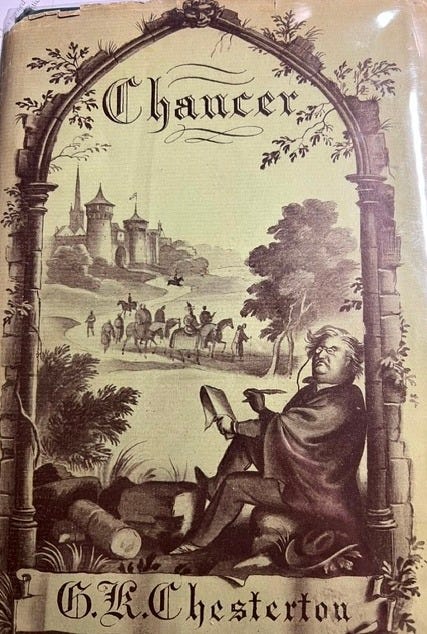
Finally, G.K. Chesterton describes the impact that the author of The Canterbury Tales (published in 1476) had on his home country, indeed on all human history.
“There was never a man who was more of a Maker (poet) than Chaucer. He made a national language; he came very near to making a nation. At least without him it would probably never have been either so fine a language or so great a nation. Shakespeare and Milton were the greatest sons of their country; but Chaucer was the Father of his Country, rather in the style of George Washington. And apart from all of that, he made something that has altered all Europe more than the Newspaper: the Novel. He was a novelist when there were no novels. I mean by the novel the narrative that is not primarily an anecdote or an allegory, but is valued because of the almost accidental variety of actual human characters.” -Chaucer by G.K. Chesterton, 1903, p.5.
Geoffrey Chaucer wrote his book between 1387 and 1400. It was published decades after his death. The Canterbury Tales and their impact are a case study in perseverance.
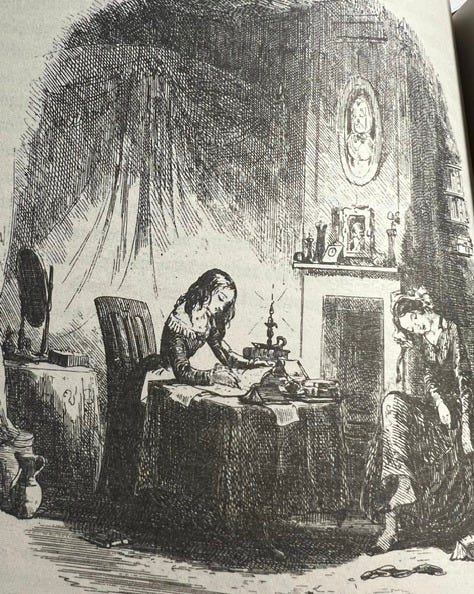
I have to add one bonus quote from Dickens. Dombey and Son beautifully describes the relationship between Florence Dombey and her sickly younger brother Paul. Paul, as the heir of the family business, is thrown into the deep end of learning. The boarding school requirements overwhelm him. So, his sister buys her own copies of his books and sets to learning them so she can help him catch up on his lessons. Dickens captures the true source of all such perseverance, whether as a pastor, an author, or a good member of your family. I hope you enjoy it as much as I do:
“…Florence sat down at night to track Paul’s footsteps through the thorny ways of learning, and being possessed of a naturally quick and sound capacity, and taught by that most wonderful of masters, love, it was not long before she gained upon Paul’s heels, and caught and passed him.” p.177 Dickens
See Psalm 1.
Fascinating! Keep on persevering with hope!