
Seeking Wisdom in Italy
A New Commentary on Proverbs 4:7

The beginning of wisdom is this: Get wisdom. Though it cost all you have, get understanding. -Proverbs 4:7
A few days before our recent trip to Tuscany, I was feeling wonderfully self-satisfied. I was preparing for our adventure by packing, getting an international driver’s license, purchasing tickets, and making reservations. I was also going above and beyond by reading a 14th-century epic poem by the man considered not only the greatest Italian poet of all time but the author of one of the greatest works of literary history in the world. I felt quite intellectual and scholarly. After all, how many tourists traveling to Tuscany are reading Dante Alighieri’s Divine Comedy? I also felt like a good Jesus follower. I believe that the adventure of seeking deeper understanding should be a major pursuit in all of our lives. Little did I know that this adventure was going to take me to places I never thought I would go.
It began when I turned to the last page of Dante’s Canto XXI. My sense of self-satisfaction evaporated when I read the final sentence:
“And he made a trumpet of his ass.”
Hmm.
Now, I’m not one of those guys who gets excited by bodily functions. As a matter fact, I have learned, as a father of two boys, that I am on the extreme opposite of the continuum. And I’ve realized that I need to lighten up. The book of Isaiah, in one of those passages of the Bible I have never heard preached, helped me a little bit in that regard:
We were with child, we writhed in labor, but we gave birth to wind. -Isaiah 26:18
The earthy prophet used the same bodily function, with wit and irony, to show how much his people were missing the goal of God’s promise to them. Now Dante was using the same metaphor to depict the grotesque among demons and, through them, in humanity.
The odd thing is that when I read Dante’s words, I experienced, not just my standard abhorrence, but an unexpected excitement. This phrase moved me forward in the pursuit of understanding. For, at the same time as I read those eight words, another image, an illustration that had always perplexed me, popped into my mind:
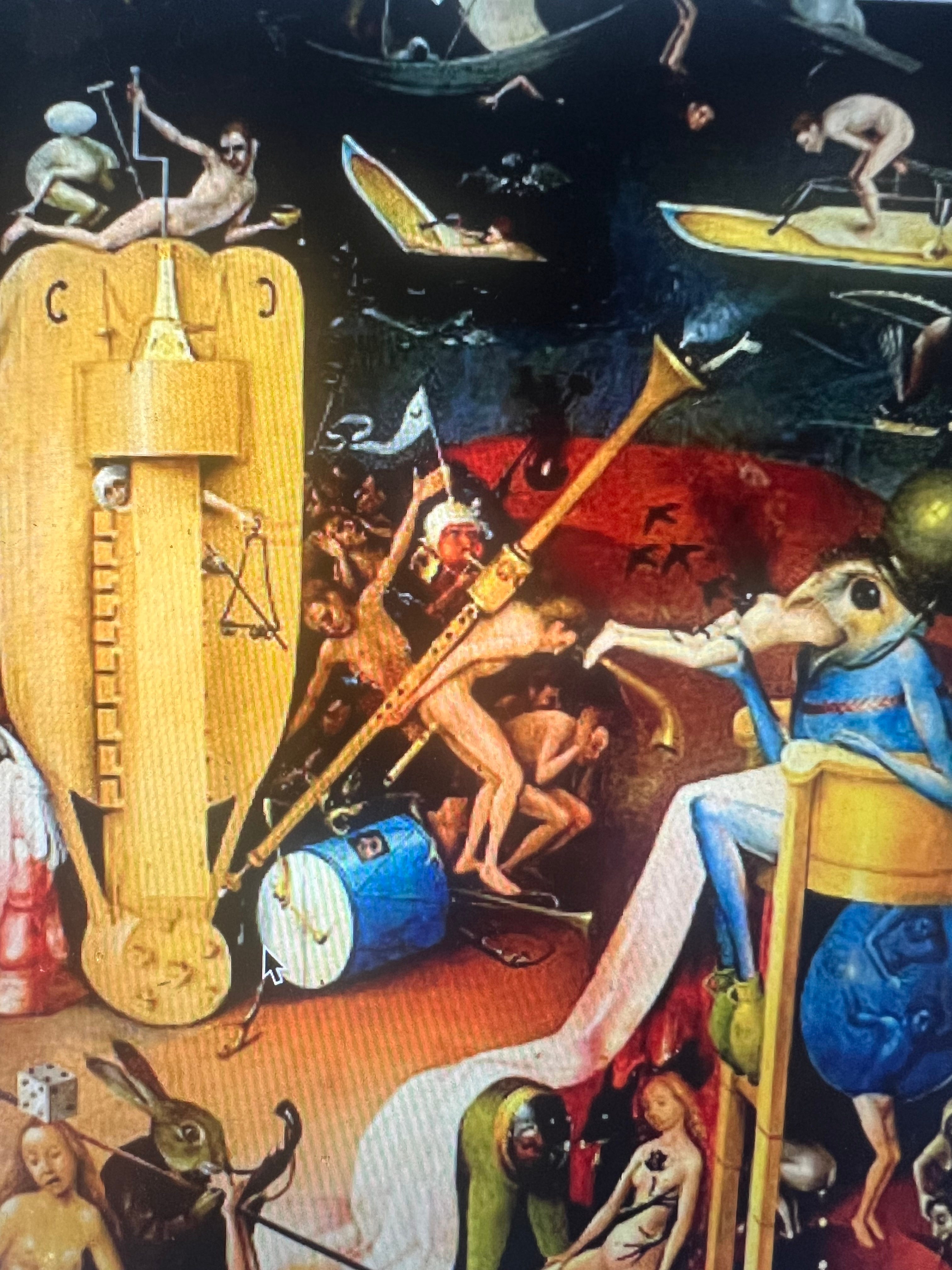
The man with an awkwardly placed flute is, as you can see, one of hundreds of grotesque figures in Hieronymous Bosch’s famous 15th-century Garden of Earthly Delights. All of them are perplexing. But now, after reading the end of Dante’s Canto XXI, I can take another step on the adventure of wisdom. I doubt it will lead to great riches. I am a little trepidatious as to where it will lead. But now I know that Bosch was inspired by Dante. I wasn’t sure how, exactly, but I knew I had taken another step on my journey for deeper understanding.
Canto XXI, in Dante’s journey from sin to salvation, describes corrupt public officials reaping what they have sown in their lifetimes. Magistrates who took bribes, city councilors who filed lawsuits to slow down the wheels of justice, and hinder their political foes. As Dante and his guide watch, they are plunged into a river of boiling pitch by a gang of demons who warned of more suffering if they dare to emerge to breathe the air. These same demons agree to take them to the next section of hell, and the journey begins with the trumpet under discussion announcing the journey’s beginning. As Dante writes in the next Canto, “…never have I seen horsemen or seen infantry…move to so strange a bugle.”
When my wife and I arrived in Bologna a week later, we found our next step on this journey for understanding. On our Airbnb tour of “The Secrets of Bologna,” our guide, Mersedeh, showed us a church with round-the-clock military protection. She asked us why we thought such a thing would be necessary. It turns out that the Basilica of San Petronio contains a 15th-century painting by Giovanni de Modena, which has so upset some people that they have tried to bomb it out of existence. She didn’t take us inside, but Cheryl and I knew we had to return to see this “secret of Barcelona” ourselves.
As soon as I saw the massive painting, I knew two of Modena’s sources.
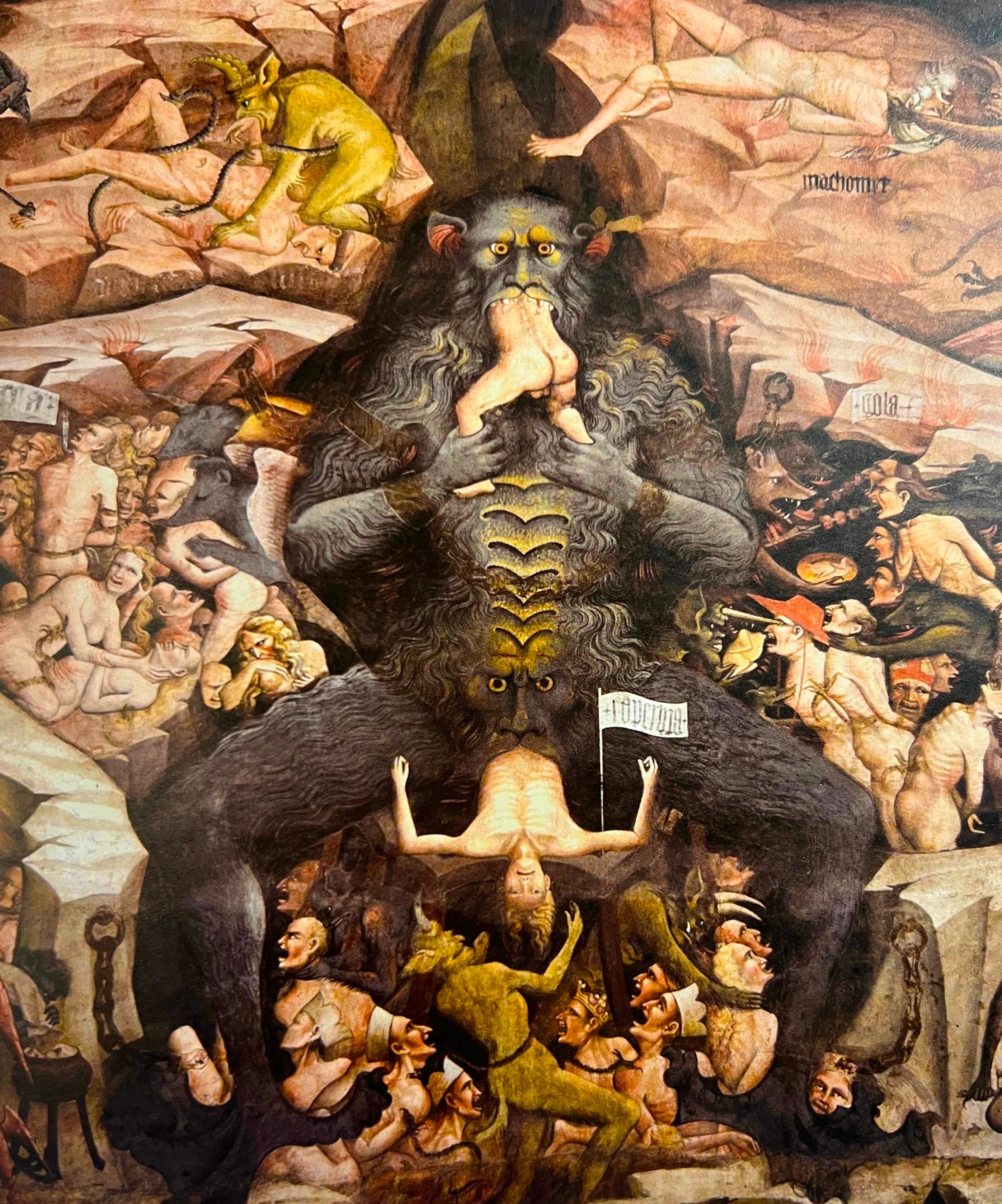
Once inside the church, we found that the section of the chapel that contained the painting was roped off and could only be entered after paying a fee. They didn’t allow photographs, though some other visitors were furtively snapping photos. The photo above (from a book I purchased!) is only one part of Giovanni Modena’s work. Like the third part of Bosch’s triptych and like the first book of Dante’s Divine Comedy, it depicts hell. Modena’s depiction is organized according to the seven deadly sins. One section portrays those who committed sins of pride. Others showed the result of the seeds sown by the envious, the wrathful, the gluttonous, the lustful, the slothful, and the greedy.
At the center of this section is the horrifying portrayal of Lucifer crushing two famous traitors in his two mouths: Judas Iscariot and Brutus. In the upper right-hand corner is the reason for the soldiers. For 280 years, beginning with the conquest of Sicily in 827, the followers of this religious leader sought control over the Italian people. Can you see who it is?
The next step in my strange pursuit of understanding continued a few days later.
When we arrived at our hotel in Tuscany, the next step was sitting on our coffee table. I wouldn’t have given the book much notice if I hadn’t been on this particular adventure. Since I was, it caught my eye immediately. As I read the dust jacket and introduction, I learned that a few centuries after Bosch and Modena, the English poet, painter, and printmaker, William Blake (1757-1827) was inspired to draw over 100 illustrations of The Divine Comedy. He took on this additional project late in his life. The resulting illustrations, in various forms of development at the time of his death, had never been brought together in one book…until now. As I thumbed through the book’s well-produced pages, I was excited to find four illustrations inspired by Canto XXI. I knew that reading this book would help me continue my journey.
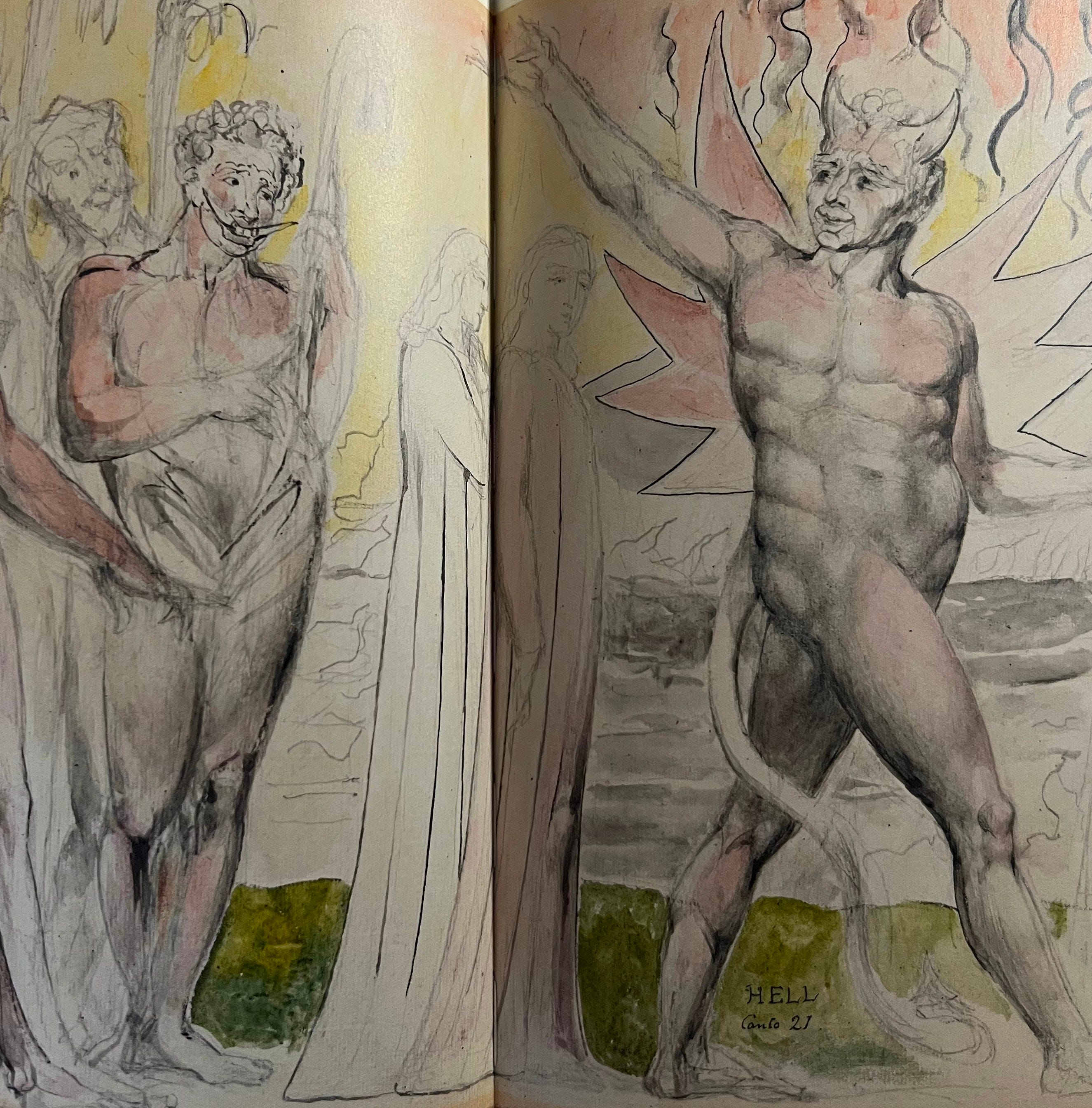
There were too many amazing things to see and experience in Tuscany! I had read only a few pages of the book that piqued my interest. We had made friends with a very kind young man named Samuel. Since he worked at the front desk of the hotel, I asked him if he would see if the hotel would consider selling the book to me. With his usual level of energy and enthusiasm, he agreed to look into it.
That evening, as my wife and I were having dinner in the hotel bar, Samuel approached our table with a dampened spirit. “I checked about the book, he said, and there is nothing the hotel can do.” It was strange, but the Margherita pizza in front of us drew me quickly back to our meal.
When we returned to our room, there was a gift, wrapped up and sealed with a local flower, sitting on the table. It was the book! The accompanying card was signed by Samuel and the hotel staff, expressing their joy in giving us the book for free.
My journey would continue!
Now that I am back in the U.S., I have more reading to do. I have another fifteen Cantos of Dante to read with the book on Blake’s illustrations. I also have other unanswered questions to pursue:
Who was Dante influenced by?
What passages of the Bible were most influential over the almost 13 years Dante took to write his epic poem?
What was the common vision of hell and paradise before Dante wrote?
How does Dante continue to influence our thinking about those subjects today?
A few other relevant questions:
Will I make any money from this pursuit of understanding? At this point, I would say it is highly doubtful.
Do I know if any of this information will be helpful beyond an Italian game of Trivial Pursuit and this Substack post? Unknown.
Has it been fun to explore this path, and do I want to continue on this journey? Without a doubt.
I so enjoy seeking understanding. So, I conclude this post with a hearty affirmation of Proverbs 4:7:
The beginning of wisdom is this: Get wisdom. Though it cost all you have, get understanding.
What adventures of understanding are you taking?
Wow! What a fascinating journey you were on, Randy, not only for your trip but also for your journey of discovery and wisdom! I found all of this to be so interesting and engaging ~ thank you for sharing all of this with us here!
P.S. How very kind of the hotel staff to gift you with that book! What a lovely and memorable way to end your time in beautiful Italy. 😊