
Writer's Workbook 2: Word Power (Pt. 1)
Skills I'm sharpening while writing my second book.

Blessed is the one who does not walk in step with the wicked or stand in the way that sinners take or sit in the company of mockers,
but whose delight is in the law of the Lord, and who meditates on his law day and night.
-Psalm 1:1-2
I am always searching for mentors, for people who are far ahead of me in a certain skill. If that were the only criterion, they would be easy to find. But I have two criteria. That makes the task much more difficult, especially when it comes to artists.
I remember finding a Dali painting that was perfect for the sermon I was preaching. I put the bulletin proof for that Sunday in my office administrator’s inbox and continued working on the sermon. About half an hour later, I heard a light knock at my office door. It was Patti, my office administrator, pointing out, as delicately as possible, that the elephant in the painting had no decorum when it came to his male biology. Maybe that wasn’t a perfect painting for the bulletin after all.
I had a similar letdown when it came to the poet Charles Baudelaire. I kept reading about the power of his poetry. I hesitated to buy a collection of his poems entitled “The Flowers of Evil,” but when I found a 1st edition autographed by … as a gift for… I jumped. His ability to draw out personal experiences with just a few well chosen words was, indeed, amazing.
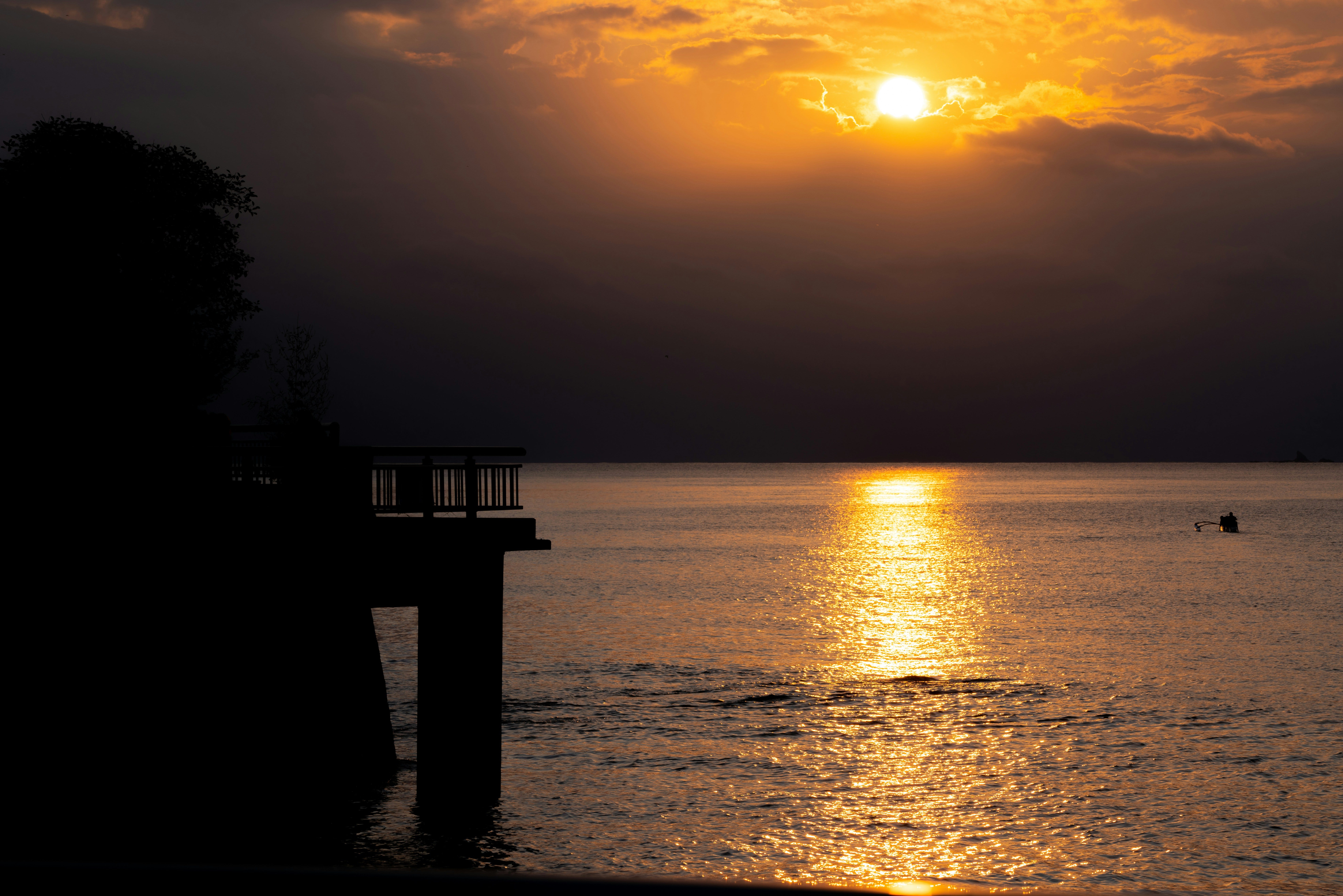
For example, I have a fondness for the ocean since it was a constant in so many of the countries I have called home. In primary school, I was in Sydney, off the Tasman Sea, which connects to the Pacific Ocean. In Houston, I was near the Gulf, which connects with the Atlantic Ocean. In Honduras, I lived on an island in the Caribbean Sea which is part of the Atlantic Ocean. In Los Angeles, I am next to the Pacific Ocean. In Mozambique, I lived within view of the Indian Ocean. In each location, when I sat on the local beach and looked out on the water, I imagined travelling across the ocean to one of the other places I had lived. The ocean kept me whole, though my memories were scattered across many lands. All of this meaning came rushing from memory into my consciousness when I read Baudelaire’s phrase:
“The ocean, strewn with sliding images of the sky…”
Wow! In nine words, he changed my thoughts and emotions.
The experience of reading his poem entitled “My Former Life” caused me to doubt the folk wisdom that teaches us that a picture is worth a thousand words. I had just learned that a few well-chosen, melodic, and inspiring words are worth much more than the 2 million pixels needed for a photograph.
His poem, “My Former Life” begins this way:
I can remember a country of long, high colonnades
Which mirrored in their pale marble the prismatic light
Cast from the bright sea billows in a thousand shades,
And which resembled a cave of fluted basalt1 by night.
After these few lines, I knew I was reading a master poet. My first criterion for a mentor was met. I want to learn to unleash the power and beauty of words and I can clearly learn from Baudelaire.
The ocean, strewn with sliding images of the sky,
Would mingle in a mysterious and solemn way,
Under the wild brief sunset, its tremendous cry
With the reflected colours of ruined day.
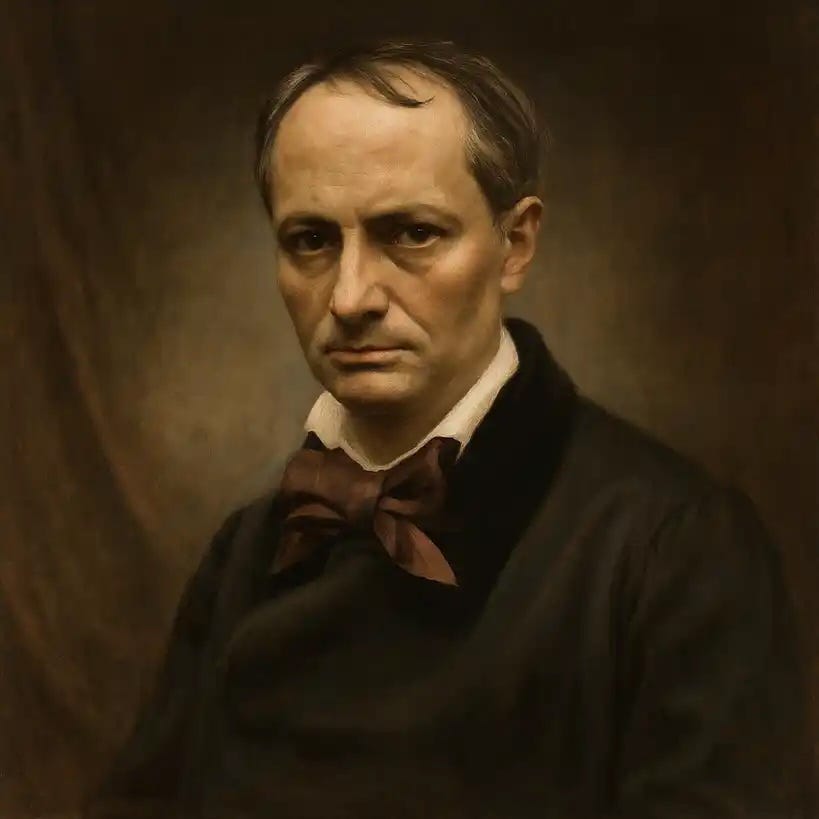
But then there is that pesky second criterion. I want my mentors to not only be masters of their craft, but to live a life worth emulating as well.
I suppose this criterion was set for me in a reformed theology class in seminary. My professor was clearly a master of his area of specialty. He was well spoken, organized, and I learned many things I had not understood before. Criterion number one was complete. He knew his subject. But he also knew how good he was at his subject. As he taught us about Christ, he conveyed his own pride. I decided I would rather learn from the uneducated Honduran refugee pastors I had worked with on the island of Amapala years before. Their knowledge was real to me because you could see it transforming their lives.
Baudelaire’s poem had impressed me thus far. The sunset as “reflected colours of ruined day,” had worried me a bit. Where was this poem going? Then I read the next section:
There did I dwell in quiet luxury apart,
Amid the slowly changing hues of clouds and waves;
And there I was attended by two naked slaves…
Okay. Now I was really worried. So, I decided to test my second criterion with a dive into Baudelaire’s biography. His life made sense of his poem. But he failed my second criterion for a mentor. His life was a disaster.
Baudelaire’s promise emerged as a student when he wrote his earliest poems.
He regularly sank into deep melancholy. This certainly doesn’t exclude a potential mentor. The key question is what he does with it.
He tried to break through his melancholy with, shall we say, “undisciplined acts.” This dark and dreary path gave him first contact with the literary world. It also resulted in the disease that would eventually kill him.
He came into a large inheritance. (Could this be the “dwelling in quiet luxury” he is writing about?) but wasted his money on expensive clothing, books and paintings, lavish food and wine, as well as hashish and opium. He then struggled with finances for the rest of his life. (Maybe this is why the poem is entitled, “My Former Life.”
When I read Baudelaire, his words, both beautiful and gross, have their effect on me. But reading him felt much more like enchantment, like temptation, than enjoyment. He could never be my mentor because I am afraid of where his words will take my mind.
So, my search continues for a poet of the last few centuries who knew how to use the power of words and lived a life worthy of emulation. My search took me to one of the great hymn writers in the last few centuries, Isaac Watts.
Let’s look at how he uses the power of words, in his poetry and in his life, in our next post.
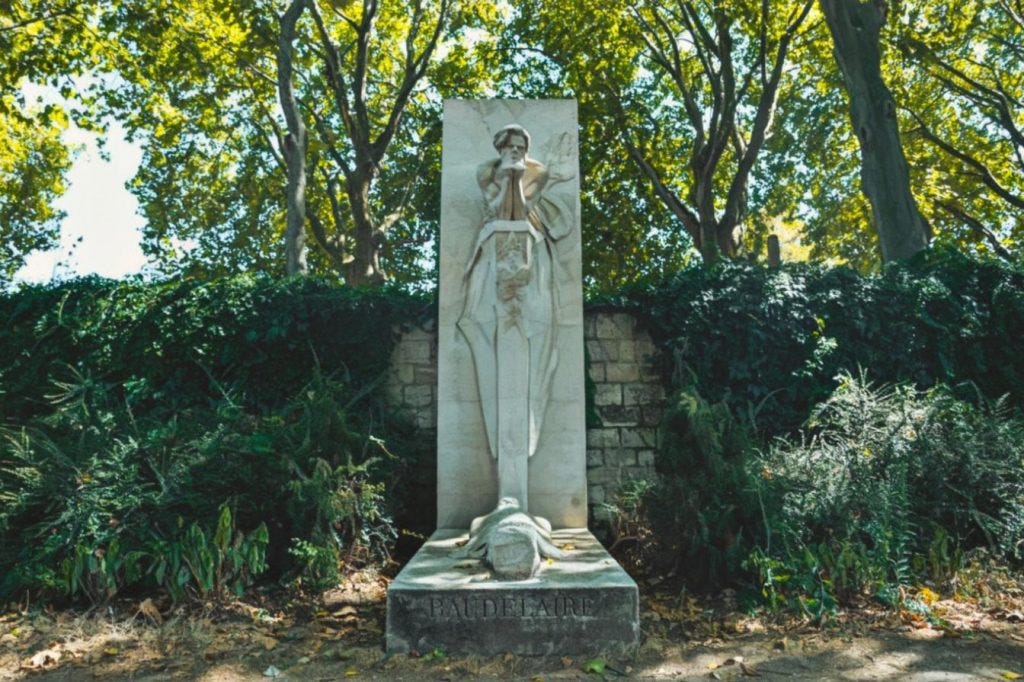
Fluted basalt is a type of stone characterized by its dark grey background and regular, parallel grooves. This design creates a three-dimensional texture that enhances light and shadow effects, making it popular in modern architectural facades.