

‘Son of man, prophesy against the shepherds of Israel; prophesy and say to them: “This is what the Sovereign Lord says: woe to you shepherds of Israel who only take care of yourselves! Should not shepherds take care of the flock? -Ezekiel 34:2
It isn’t bad to read the book of Ezekiel from beginning to end. How much better, though, to hear it in stereo!
Struggling students often turn to music appreciation for an easy A. Nevertheless, if you take the class seriously, it opens up a whole new world of art and enjoyment. By studying a piece's historical context, cultural significance, and musical elements, you can understand and enjoy its music more deeply. That is the course's goal. We need a course in Prophet Appreciation that can serve the same purpose. This post invites us to look more deeply into one of Ezekiel’s works of art.
Let’s start with the wider historical context of our prophet. Ezekiel’s creativity flourished as he participated in God’s wider story. That story begins in earnest with God’s promise to Abram (later Abraham) in Genesis 12. As we read the rest of Genesis, the promise to make his family into a great nation, to bless those who bless him and curse those who curse him, to make his name great, and to bless the world through him leads Abraham and his family through many dangers, toils, and snares; many of them originating in the lack of faith among Abram’s family. However, God proves faithful to his commitment. In Leviticus, God’s story expands from Abram and Sarai to the 12 tribes of Israel. Leviticus 26 formalizes the promise, with blessings if the nation of Israel keeps its side of the commitment and a clear description of the consequences of breaking its word. Deuteronomy 27-30 further develops this covenant of blessings and curses. By the time we get to the prophets, all of them, from Ezekiel to Hosea to Micah, understand their role in the story according to Leviticus 26 and Deuteronomy 27-30. Their works of art are not creations ex nihilo. They riff on the covenant's words.

If their people had kept their promise, their prophets’ words could have been beautiful and encouraging. Unfortunately, given the context each of them found themselves in, they spent most of their prophetic creativity depicting coming disasters. But if we look at the gallery of all the prophets, including Ezekiel, we find many beautiful descriptions of a future that will come despite the breaking of the covenant. God’s promise to Abram still holds.
With that in mind, we now focus on Ezekiel as an artist. One of the first emotions we experience as we begin reading chapter one is tragedy. It continues to dominate his 48 chapters. This makes Ezekiel difficult to read as a morning devotional. Most of us are looking for encouragement, not disturbing images of human faithlessness. Yet if we understand Ezekiel as art (see last post), we can find a way to take in and benefit from what Ezekiel offers. Think about it. We know how to read and even appreciate tragedies: think Hamlet, The Grapes of Wrath, and A Farewell to Arms. We can do the same with Ezekiel.
Now we are ready to practice our Prophet Appreciation on a particular work of Ezekiel. Let’s focus on his art in chapter 34. Before continuing this post, take time to listen to the chapter as read by actor David Suchet here. Note what images, words, and themes capture your imagination.
Now that you have your list, here are some of the things that stood out to me:
Ezekiel is painting a pastoral theme: think shepherds and flocks of sheep.
The story arc:
What is the problem? As we look closer, we see the shepherds, some dressed as political leaders and others as pastors and priests, turned away from the flock and focused on their own needs. When we focus on the sheep, we see them scattering. This is the key problem he is addressing.
What is the solution? God will take over the shepherds' responsibilities. He will deal with the bad shepherds and bring the scattered flock back together. As we look more closely at this part of Ezekiel’s art, we see the Good Shepherd gathering strays and focusing on them: nurturing the sick, feeding the flock from the finest pasture, and protecting them from enemies inside or outside the flock. It is a pastoral scene of everlasting peace with the Shepherd and the reconstituted flock, with all of the blessings of Leviticus 26 and Deuteronomy 27-30.
Take time now:
to consider how this pastoral scene speaks to you today.
If you want to take it to the next level of Prophet Appreciation, think about other pastoral scenes painted in the Bible. The first that comes to my mind is the very well-known Psalm 23. With Ezekiel’s art in mind, I read David’s Psalm and heard it with a new power. He experienced the blessings of holding to the covenant.
The Lord is my shepherd, I lack nothing.
He makes me lie down in green pastures,
he leads me beside quiet waters,
he refreshes my soul.
He guides me along the right paths
for his name’s sake.
Even though I walk
through the darkest valley,
I will fear no evil,
for you are with me;
your rod and your staff,
they comfort me.
You prepare a table before me
in the presence of my enemies.
You anoint my head with oil;
my cup overflows.
Surely your goodness and love will follow me
all the days of my life,
and I will dwell in the house of the Lord
for ever.
Then I did a Bible search for other writings about “The Good Shepherd.” I was drawn to a painting of Jesus in John. Listen to John 10 to see how Jesus develops Ezekiel and David’s theme.
What connections do you see?
Here is what stood out to me:
Jesus, like Ezekiel and David, is painting a pastoral scene: I envision shepherds and flocks of sheep.
The story arc:
The problem is similar to Ezekiel: Jesus puts it this way: Thieves and robbers break into the sheepfold; the hired shepherds, still dressed as political leaders and priests, run away, and the flock is scattered.
The solution is quite close to Ezekiel, akin to what David experienced in Psalm 23. God has appointed Jesus to take over the Good Shepherd role. The hired shepherds run away. Jesus lays down his life for the sheep. His sheep are drawn back to him by his voice, and it isn’t just the flock of Israel, but sheep from other sheepfolds that come together; one flock under one Good Shepherd. Jesus says that none of his flock can be taken away from him.
What else do you see in the comparison of the three passages?
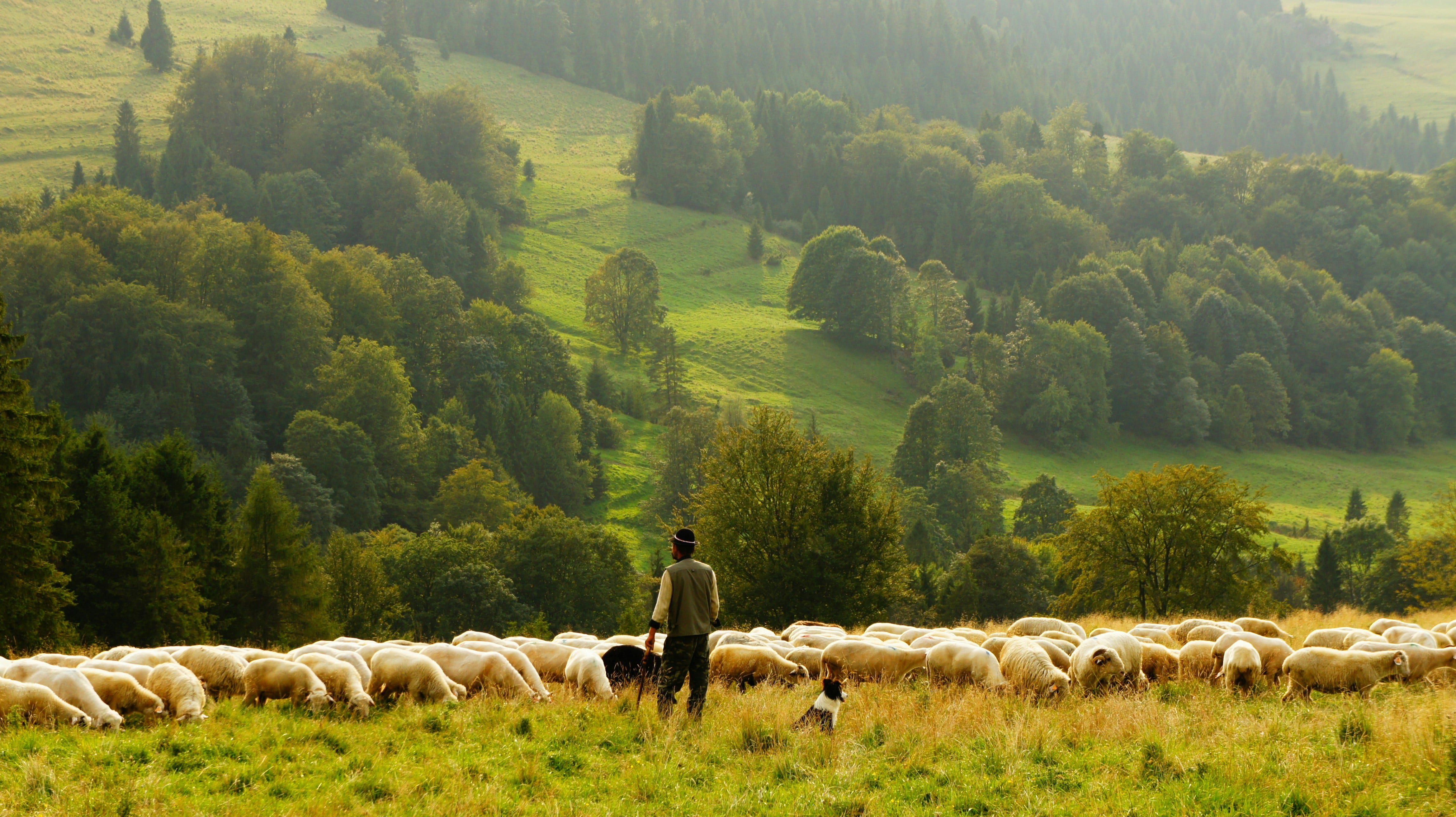
We could paint our own version of this pastoral theme. Even after Jesus assumed the role of “Good Shepherd,” hired shepherds try to usurp his role. We could sketch political and religious leaders in our day, as Ezekiel did, “eating the curds, clothing themselves with the wool and slaughtering the choice animals, but not taking care of the flock.”1 But I would set that sketch on one side of the canvas, focusing more on our Good Shepherd. His flock, even while the bad shepherds, and thieves, the wild animals, and wolves prowl, listen first and foremost to Jesus’ voice. They “lay down in green pastures, are led beside still waters and refresh their souls.
It isn’t bad to read the book of Ezekiel from beginning to end. How much better, though, to hear it in stereo!
Ezekiel 34:3